
Why Do People Buy a Particular Piece of Art?

Updated: Sep 26
Why Do People Buy a Particular Piece of Art?
Why do people buy a particular piece of art?
How My Childhood Memories Find Their Way Into My Paintings
I've thought about this question quite a lot, both as an artist and as someone who has looked at enough paintings to know that choosing one isn't always as simple as saying, "I like this one."
There can be practical reasons.
You might love the colours. You might like the subject, the composition or the size.
Perhaps you have a particular wall in mind and you can already imagine the painting hanging there.
But then there are the reasons that are harder to explain.
A painting might remind you of a place you once visited. A particular colour might bring back your childhood room. A landscape might make you think of a holiday, a person you miss, a book you loved, or a life you once imagined for yourself.
And sometimes, none of those things happen.
You just keep looking at it.
You see it once, scroll past it, and then find yourself going back.
You look at it again the next day.
You start imagining it in your home.
You don't completely understand why this particular painting has stayed in your mind when there were hundreds of others you could have looked at.
But it has.
I think that is one of the most interesting things about art.
We can talk about colour, composition, subject, size, technique and style. We can discuss whether something works with a particular room or whether it fits within a budget.
All of those things matter.
But underneath them is another question that is much more personal:
How does this artwork make me feel?
That answer will be different for everyone.

One person may see peace in a painting. Another may see nostalgia. Someone else may see beauty, curiosity, comfort, mystery or even something they can't quite name.
And I think that's where the relationship with an artwork really begins.
Because people don't only choose art with their eyes.
They choose it with their memories, their imagination, their experiences and sometimes with a part of themselves they didn't even realise was looking for something.
Art Isn't Always a Logical Decision
We are used to making decisions by comparing things.
If we're buying a phone, we compare the camera, storage, battery, features and price.
If we're buying a chair, we think about its size, comfort, material and whether it will work in the room.
Even when we're buying something for our home, there is usually a practical list somewhere in our head.
Art can be different.
Of course, practical things still matter. You might measure your wall. You might think about the size of the artwork, the price, the colours in your room or whether you have space for it.
But after all of that, there can still be one painting that keeps pulling your attention.
Imagine looking through a collection of paintings.
There are two you really like.
They are similar in size. You like the colours in both. Both would work in your home.
On paper, there isn't much separating them.
And yet you keep going back to one.
You open it again.
You look at the details.
You imagine it hanging above your desk.
You wonder how it would look in the evening light.
That reaction doesn't always come from a carefully reasoned decision.
And I think we sometimes feel uncomfortable with that, especially when the artwork is something we are actually considering bringing home.
We want a good reason.
We want to be able to explain our choice.
But perhaps you don't need to.
Art isn't a mathematical equation where one painting has to score higher than another.
Sometimes the artwork you connect with is simply the one your eyes keep returning to.
And that is worth noticing.
The First Thing We Often Respond To Is How the Artwork Makes Us Feel
Before we start analysing a painting, we usually experience it.
You might see an artwork and immediately feel calm.
Another painting might make you curious.
One might make you smile.
Another might remind you of something you haven't thought about in years.
You might be looking through your phone late at night and suddenly stop because an image feels strangely familiar.
You might be walking through a gallery and after seeing dozens of paintings, find yourself turning around to look at one again.
That first reaction can happen before you have the words for it.
You don't necessarily know why you stopped.
You just did.
I find this particularly interesting when I think about the kind of paintings I naturally make.
I'm often drawn to things that already carry a feeling for me — nature, animals, birds, little corners of rooms, books, windows, warm lights, childhood memories and ordinary moments that feel a little magical when you slow down enough to notice them.
I like painting things that can create the feeling of entering another little world.

It could be an underwater scene filled with colour.
It could be an animal surrounded by an unusual atmosphere.
It could be a room with a window and warm light.
It could be a landscape that makes you want to imagine what lies beyond it.
When I'm painting, I don't think only about what I want the viewer to see.
I think about what I want them to experience.
Maybe they feel peaceful.
Maybe they become curious.
Maybe something reminds them of childhood.
Maybe they simply enjoy the colours.
Or perhaps the painting means something completely different to them.
And I'm perfectly comfortable with that.
I don't think an artist should always tell the viewer exactly what they are supposed to feel.
A painting should leave some room for the person looking at it.
Room for their memories.
Their imagination.
Their own life.
If you're curious about the kinds of little worlds I create, you can take a look at my paintings here.
Sometimes a Painting Reminds Us of Something
This is one of the reasons art can feel surprisingly personal.
A painting doesn't have to show your actual memory to bring it back.
It might only contain one small thing that feels familiar.
A window.
A tree.
A chair.
A particular kind of light.
A garden.
A colour.
A little room.
Imagine seeing a painting of a warm room with a lamp glowing beside a window.
For one person, it might simply be a beautiful interior.
For someone else, it could bring back memories of reading beside a window as a child.
Someone else might think about their grandmother's house.
Another person might see it and immediately imagine the kind of home they would like to have someday.

The painting hasn't changed.
The memory has.
And sometimes the memory isn't even very clear.
You might not think, "This reminds me of that exact afternoon when I was eight."
It can be much simpler.
You just get a feeling of familiarity.
A feeling that you've somehow been there before.
I've always found that fascinating because the artist doesn't own the viewer's memories.
I can begin a painting with my own idea, my own memories and my own reasons for making it.
But once someone else looks at it, they bring their own life into it.
That is where the artwork starts becoming personal in a completely different way.
A painting of a little house beside a tree could mean home to one person.
Childhood to another.
Freedom to someone else.
For another person, it might simply be a beautiful combination of colours.
There isn't necessarily one correct response.
The painting is the same.
The life looking at it is different.
And perhaps that is why an artwork can feel familiar even when you've never seen it before.
It may not remind you of an image.
It may remind you of a feeling.
Sometimes You Don't Know Why You Like It
Have you ever looked at a painting and thought,
"I don't know why, but I really like this."
I have.
And I think that's a perfectly good place to begin.
There doesn't always have to be a story behind your reaction.
You might love the colours.
You might like the way the composition feels.
You might be drawn to one tiny detail.
You might like the atmosphere without being able to explain what created it.
Or perhaps there is something about the painting that feels familiar, even though you can't identify what it reminds you of.
I've also found that the paintings we don't immediately understand can sometimes stay in our minds for longer.
You see something unusual.
You don't completely know what to make of it.
But you want to look again.
That curiosity can be just as powerful as familiarity.
As an artist, I don't expect everyone to understand exactly what I was thinking when I made a painting.
In fact, I like the idea that someone can see something in my work that I didn't consciously put there.

They might notice a tiny detail that I almost forgot about.
They might create a story around a scene that began with a completely different idea in my mind.
They might connect it to a memory that has nothing to do with my own life.
That's not the artwork being misunderstood.
That's the artwork being experienced.
And sometimes, "I really like this" is enough.
You don't need to write an essay about why.
You don't need to understand every decision the artist made.
You don't even need to know the artist's intention.
You can simply look at it and notice that something in you responds.
We Don't Just Buy the Artwork — We Choose to Live With It
This is where choosing a piece of art becomes different from simply liking an image.
When you bring a painting into your home, you're going to see it again.
And again.
And again.
Perhaps it hangs above your desk.
You see it while answering emails.
You see it when you're drinking your morning coffee.
You walk past it while looking for a book.
You notice it when you're cleaning the room.
You see it in the soft evening light.
And eventually, you stop noticing it in the same way you did on the first day.
Not because you stopped loving it.
Because it has become part of your surroundings.

It belongs there.
I think that's one of the beautiful things about living with art.
A painting isn't something you use once and put away.
It stays with you.
And the longer it stays, the more memories can become attached to it.
Perhaps you bought it when you moved into your first home.
Perhaps it was the first original painting you ever owned.
Perhaps you bought it after reaching an important point in your life.
Perhaps someone gave it to you.
Or perhaps you simply saw it one day and thought, "I want this in my home."
Years later, the painting can remind you of that version of yourself.
The artwork itself hasn't changed.
But you have.
That is when art can become more than decoration.
Of course, a beautiful painting can change the feeling of a room.
It can bring colour and personality into a space.
But when you genuinely connect with it, the relationship can become much more personal.
You are no longer asking only,
"Will this look good on my wall?"
You are also asking,
"Do I want to live with this?"
I think that is a very different question.
And perhaps it is one of the most important questions to ask before bringing an original painting home.
If you're looking for an original painting to live with rather than simply decorate with, you can explore the original artworks I've made here. Take your time looking through them. Some may speak to you immediately; others may take a little longer.
The Artwork Becomes Part of Your Personal Story
Something interesting happens after we live with an artwork for a while.
Its meaning can grow.
Maybe you originally chose it because of the colours.
Maybe you loved the subject.
Maybe you simply thought it was beautiful.
But then life continues around it.
You move houses.
You change jobs.
You meet people.
You lose people.
You grow older.
You go through difficult seasons and happy ones.
And the painting is still there.
Maybe it has moved from one room to another.
Maybe it has followed you from one home to the next.

Maybe it used to hang beside your work desk and now it hangs in your bedroom.
Every place it has lived becomes part of its history with you.
You might eventually look at it and remember something that had nothing to do with the reason you originally bought it.
That's what I find so special.
The artist may have created the first story.
But the owner keeps adding to it.
A painting can begin as something you simply loved looking at.
Then it becomes part of a home.
Then part of a period of your life.
And eventually, it can become connected to memories that you never imagined when you first saw it.
In that way, an artwork can quietly become a witness to your life.
It doesn't speak.
It doesn't change.
It simply remains there while everything around it does.
And years later, you may realise that you don't only love the painting.
You love what it has come to represent.
Why Two People Can See the Same Painting Differently
Imagine a painting of a little house surrounded by trees.
There is a path leading towards it.
The light is soft.
There are trees around the house and a wide sky above it.
Now imagine four people standing in front of that painting.
One person sees their dream home.
Another remembers their childhood.
Someone else thinks about a trip they once took.
And another person simply thinks,
"I love those colours."

They are all looking at exactly the same painting.
But they aren't experiencing exactly the same thing.
We never come to art with an empty mind.
We bring our memories with us.
We bring our experiences.
We bring our imagination.
We bring whatever happened to us that morning.
Even our mood can affect what we notice.
A painting that feels comforting on one day might feel nostalgic on another.
A detail you completely overlooked might suddenly become the most interesting part of the painting a year later.
This is one of the things I love about being an artist.
I can make the painting.
I can decide the colours, forms, composition, atmosphere and details.
But I cannot decide what someone else's life will bring to it.
And I don't want to.
If I paint a little room with a lamp and a window because I love the feeling of a quiet evening, someone else might look at it and think about their childhood bedroom.
Someone might think about a book they used to read.
Someone might imagine a home they haven't found yet.
Someone else might simply enjoy the warmth of the colours.
All of those experiences can exist beside each other.
The painting doesn't have to have only one meaning.
It can have a beginning without having only one ending.
A Little Moment That Made Me Think About This
I've actually experienced this with one of my own paintings.
One day, two AC repair people came to my home for a service. While they were working, one of them kept looking at this painting.
After a while, he asked me, “Did you paint this?”

I said yes.
He looked at it again and seemed to be thinking quite deeply about it. I don't know what was going through his mind, but for a moment, it felt like he wasn't just looking at a painting on my wall. It seemed as though he was imagining himself somewhere inside that scene.
That little moment stayed with me.
Because I knew what this painting meant to me, but I had no idea what he was seeing in it.
I've also received completely different reactions to the same painting on social media.
Someone once commented that they saw it as a sad painting.
But someone else described a very different feeling. They saw it as those late-night moments when you're by yourself, spending time in your own company, and actually enjoying it.
I could understand both.
Because personally, this painting reminds me of my own life.
The room, the books, the warm light, the feeling of being at home with your own thoughts — these are things I genuinely enjoy. For me, there is something comforting about being alone in my own space, reading, creating, thinking, and simply enjoying my time.
So when I look at the painting, I don't see sadness.
I see a life that feels familiar to me.
But someone else can look at exactly the same scene and see loneliness.
Someone else can see peace.
Someone else can see freedom.
And another person might simply love the colours and the atmosphere.
That is probably one of the reasons I love painting.
I can put my own experience into a painting, but I can never decide what someone else will find in it.
And honestly, I wouldn't want to.
I think it is quite special when a painting leaves my studio with one story and then begins collecting completely different stories from the people who look at it.
Beauty Matters Too
Of course, not every artwork needs to unlock a childhood memory.
Sometimes you simply think something is beautiful.
And honestly, I think we should allow that to be enough.
You might love the colours.
You might like the composition.
You might be drawn to the subject.
You might like the atmosphere.
You might simply enjoy looking at it.
Perhaps you have a particular wall where you can already imagine it.
Perhaps the colours make the room feel warmer.
Perhaps you walk past it and it makes you happy.
There doesn't always need to be a deeper explanation.
I think we sometimes make art appreciation unnecessarily complicated.
We talk about symbolism, intention, meaning and emotion, all of which can be interesting, but sometimes the simplest answer is still the honest one:
"I think it's beautiful."

Beauty itself is personal.
One person might be drawn to soft colours.
Another might want something bright and full of colour.
Someone might love detailed paintings.
Someone else might prefer something simple.
There isn't one universal definition of beautiful.
And beauty doesn't have to compete with emotional connection.
You can love the colours and later discover that the painting reminds you of something.
You can connect with the story first and only later notice all the little visual details.
You can simply enjoy looking at it every day.
Sometimes there is a memory.
Sometimes there is a story.
Sometimes there is an emotion.
And sometimes there is simply beauty.
All of those are perfectly human reasons to love art.
Original Art Has Another Layer
There is something different about knowing that an artwork was physically made by another person.
When you see a painting online, you are seeing an image of it.
You can zoom in.
You can save it.
You can look at it again.
But an original painting has a physical presence that a screen can't completely reproduce.
You can see its actual size.
You can stand close to it.
You can step back.
You can notice details that photographs don't always communicate properly.
You can see it in the changing light of your own home.
And then there is the fact that the original exists only once.
That particular canvas.
That particular painting.
That particular combination of decisions.
When I work on a painting, there are so many little decisions that happen along the way.
A colour gets changed.
Something gets added.
Something gets covered.
A detail develops differently from what I originally imagined.
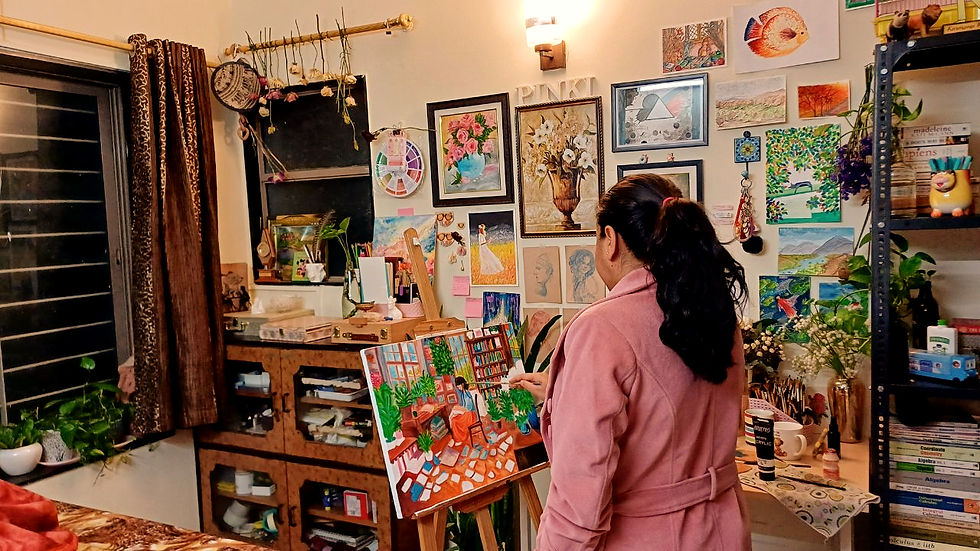
I step back from the painting.
I look again.
I leave it for a while and return to it.
All of those moments become part of the history of that particular artwork.
The finished painting doesn't show you every decision that happened in the studio.
But they are still part of it.
And when someone eventually takes that original painting home, they are not just bringing home an image.
They are bringing home something that was made by a particular person, at a particular point in time, through a particular process.
I think there is something beautiful about that.
Not because an original has to be treated like some untouchable object.
But because it has a history.
It began in an artist's studio.
And then it begins another chapter in someone else's home.
That is one of the reasons I think original art can become so personal.
It isn't endlessly reproduced as the same physical object.
There is one original.
And one person gets to live with that particular piece.
And of course, not every connection with a painting has to begin with owning the original. Sometimes you simply fall in love with an artwork and want to bring that image into your space in another way. That's one of the reasons I make art prints from some of my original paintings too.
This Is How I Think About My Own Paintings
This is probably the part of the subject that matters most to me as an artist.
When I make a painting, of course I care about whether it looks beautiful.
I care about colour.
Composition.
Light.
Details.
The overall atmosphere.
But I don't want the experience of my work to stop at,
"That's a pretty painting."
I want there to be somewhere else to go.
When I paint, I often find myself returning to the things that already feel like home to my imagination.
Nature.
Animals.
Birds.
Water.
Trees.
Books.
Windows.
Warm lamps.
Quiet rooms.
Childhood memories.
Little objects.
Ordinary moments that become more interesting when you look at them slowly.
I have always been drawn to the idea of making everyday life feel a little more magical.
Not by making everything perfect.
Just by looking at familiar things differently.
A room can become a small world.
A forest can feel like somewhere you've been before.
An animal can become part of a story.
A little corner beside a window can remind you of an entire period of your life.
That is the feeling I often carry into my paintings.
I want them to have enough detail to make you curious, but enough space for your own imagination.
Maybe you see one of my paintings and think of a place you've visited.
Maybe you think about your childhood.
Maybe you imagine a life you'd like to have.
Maybe you simply like the colours.
And maybe, years from now, you look at the same painting and realise that it has become connected to your own story.
That possibility is one of my favourite things about being an artist.
I can start the painting.
I can give it its first idea.
I can spend days or weeks building that little world.
But once it leaves my studio, I can't decide what it will mean to the person who takes it home.
And I don't think I should.

Maybe someone will find nostalgia in a painting where I was thinking about wonder.
Maybe someone's favourite part will be a tiny detail I didn't think much about.
Maybe a painting will remind them of a person, a place or a time in their life that I could never have known about.
That's the part that makes art feel bigger than the person who made it.
The painting begins with me.
But its life doesn't have to end with me.
Art Can Become Part of a Home
I think we often talk about decorating a home as though we are simply choosing things that look good together.
And of course, that matters.
But a home isn't only a collection of colours, furniture and objects.
It is where your everyday life happens.
You drink your coffee there.
You read there.
You have difficult days there.
You celebrate things there.
You fall in love there.
You grow older there.
You keep little memories there.
So the things you choose to live around can eventually become connected to that life.

This is why I think choosing artwork for your home can be different from choosing another decorative object.
A painting can become part of the atmosphere of a room, but it can also become part of the memories you create in that room.
You may remember sitting beneath it while reading.
You may remember the first house where it hung.
You may remember looking at it during a particular phase of your life.
You may move it from one wall to another and still feel that it belongs to you.
And perhaps that is what makes a piece of art feel truly personal.
It doesn't just match the room.
It belongs to the life happening inside the room.
The Artist Becomes Part of the Story Too
There is another part of owning original art that I think is easy to overlook.
You're not only connecting with the finished image.
You're connecting, in a small way, with the person who made it.
Every artist has a different way of seeing.
The subjects they return to.
The colours they naturally reach for.
The memories they carry.
The things they notice that other people might walk past.
When you buy an original painting directly from an artist, there is a human story behind that object.
There was a person sitting in a studio making it.
Thinking about it.
Changing it.
Finishing it.
And then letting it leave their hands.
I find that thought very meaningful.
Because art is one of those things where a person can leave a small part of their way of seeing the world behind.
Not literally themselves.
But their imagination.
Their attention.
Their choices.
Their time.
Their way of noticing things.
And when the artwork enters someone else's home, those things become part of another person's everyday surroundings.
That's a lovely exchange.
And sometimes that connection can begin with something much smaller. Not everyone is looking for a large painting for their home. Sometimes you simply want to keep a little piece of an artwork nearby, send it to someone, or collect a few images that mean something to you. That's one of the reasons I make art postcards from my paintings too.
So, Why Do People Buy a Particular Piece of Art?
After thinking about all of this, I don't think there is one answer.
People buy art for different reasons.
They might love the colours.
They might want something beautiful for their home.
They might be looking for a particular size.
They might have a memory connected to the subject.
They might feel something when they look at it.
They might recognise themselves in the story.
They might be curious about the artist.
They might simply keep coming back to the same painting without knowing exactly why.
And sometimes several of these things happen at once.
But I think the artworks that stay with us often have one thing in common:
They create a personal connection.
It doesn't have to be dramatic.
It doesn't have to be a profound life-changing experience.
It can be as simple as,
"This reminds me of home."
Or,
"I love looking at this."
Or,
"This feels like somewhere I want to be."
Or even,
"I don't know why, but I keep thinking about it."

That small connection can be enough.
Because when you choose an artwork, you're not only choosing something to look at.
You're choosing something you may live beside.
You may see it every morning.
You may notice it in different seasons of your life.
You may move it from one home to another.
You may one day look at it and remember exactly who you were when you bought it.
The artwork stays the same.
But your life keeps moving.
And somehow, the painting gets to move through that life with you.
That's why I don't think art is only about decoration.
It can be about beauty.
It can be about memory.
It can be about emotion.
It can be about identity.
It can be about the feeling of a particular space.
It can be about the story behind the artwork.
It can be about the artist who made it.
And eventually, it can become about you.
Art isn't only something we look at. Sometimes, it's something we live with.
If You Find Yourself Coming Back to One Painting
Ask yourself: Why do people buy a particular piece of art?
Maybe there is a painting you've been looking at lately.
You saw it somewhere and liked it.
Then you forgot about it.
Then you came across it again.
And for some reason, you stopped.
Perhaps you can already imagine it somewhere in your home.
Perhaps you like the colours.
Perhaps it reminds you of something.
Perhaps you don't know what it is.
You just know that you keep coming back.
I think that is worth paying attention to.
Not because every artwork you like needs to become something you own.
It doesn't.
But because that reaction can tell you something about what you are naturally drawn to.

Maybe you love a certain kind of colour.
Maybe you are drawn to nature.
Maybe you keep choosing paintings with windows, animals, water or little houses.
Maybe you are looking for something that makes your home feel warmer.
Maybe you are looking for a reminder of a place or time in your life.
Maybe you are simply looking for something beautiful.
Whatever the reason is, you don't have to justify it.
You can simply notice it.
Look at the painting again.
Give yourself some time with it.
And see whether the feeling stays.
Because sometimes, the artwork that stays in our mind is the one that has already started becoming personal to us.
If You Feel Like Exploring My Work
If this article made you think about the kind of artwork you would like to live with, you're welcome to wander through my little corner of the internet.
I make my paintings from the things I naturally find myself drawn to — nature, animals, childhood memories, quiet spaces, books, little magical details and ordinary moments that can become special when we slow down enough to notice them.
Some paintings are colourful and full of little details.
Some are calmer.
Some tell a more obvious story, while others leave more room for you to create your own.
I don't want every painting to tell you exactly what to feel.
I'd rather leave a little space for you to find something of your own in it.

If you're looking for a one-of-a-kind original painting, you can explore my original artworks.
If you've fallen in love with an artwork but would like a different way to bring it into your space, you'll also find art prints made from my original paintings.
And if you'd like something smaller — something to keep beside your books, add to a little collection, gift to someone, or actually send through the post — I also make art postcards from my artwork.
You don't have to arrive knowing exactly what you're looking for.
Take your time. Look around.
Let yourself be drawn to what you naturally notice.
And if one particular painting makes you stop for a little longer than the others, come back to it.
Maybe you'll understand why immediately.
Maybe you won't.
Either way, that's often how a personal connection with art begins.
Then have three simple links:


Comments